
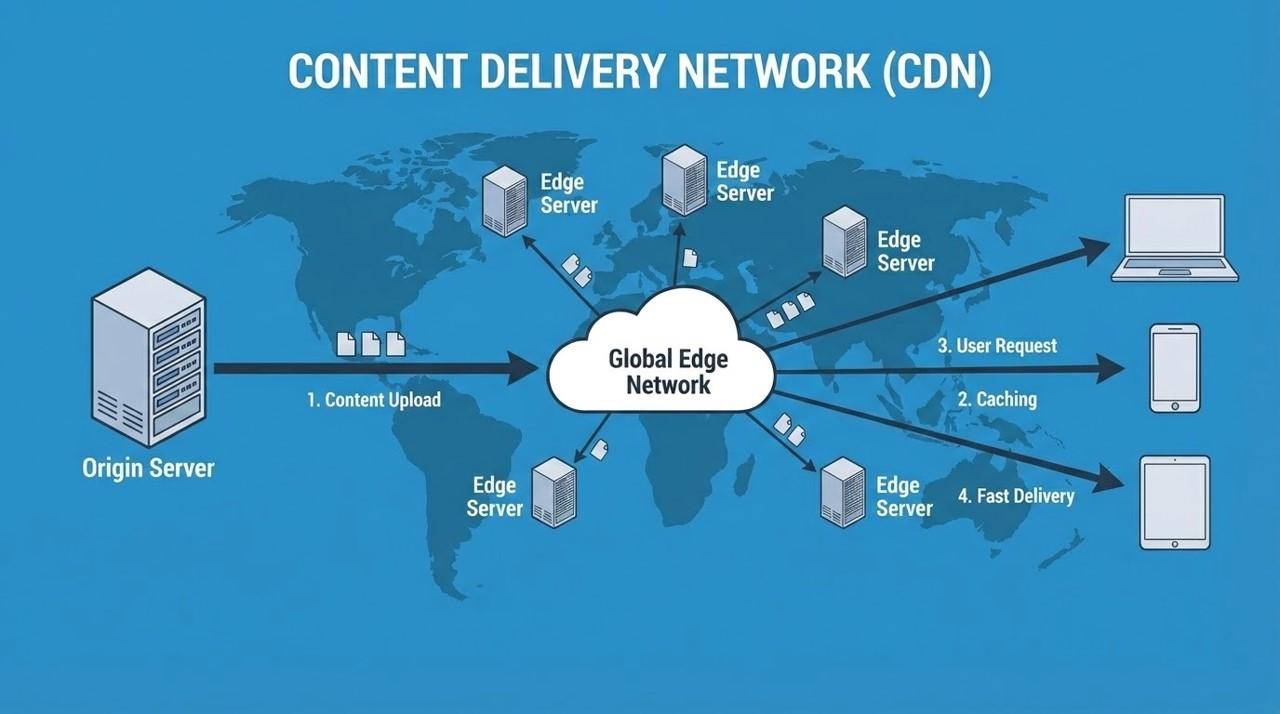
Content Delivery Networks (CDNs) revolutionized web performance by distributing content worldwide. They cache files on edge servers near users, slashing load times and handling massive traffic spikes.
What CDNs Do
CDNs act as a global proxy layer between your origin server and users. When someone requests your site’s images, CSS, videos, or scripts, the CDN serves a cached copy from the nearest edge server instead of fetching from your main server.
Key functions include:
- Caching static assets (HTML, JS, images) to reduce origin server load.
- Reducing latency via geographic proximity—New York users hit NYC POPs, not your California server.
- DDoS protection and traffic filtering at the edge.
- Load balancing across thousands of servers during peaks (e.g., Black Friday sales).
- Dynamic acceleration for APIs/videos via route optimization.
Without a CDN, a single server handles everything, causing slowdowns for distant users. CDNs deliver 99.99% uptime and 50-80% faster loads.
How CDNs Work
CDNs operate on pull or push models with edge caching:
- User request hits CDN’s Anycast DNS, routing to optimal Point of Presence (POP).
- Edge server checks cache: Hit? Serve instantly. Miss? Fetch from origin, cache, then serve.
- Intelligent routing uses BGP, GeoIP, and latency algorithms for best path.
- Purge/invalidation updates cache when origin changes (TTL or manual).
Pull CDN: Caches on-demand (Cloudflare default)—saves bandwidth but first hit is slower.
Push CDN: Preloads changes from origin (Akamai style)—ideal for dynamic sites.
POPs (edge locations) number 10,000+ globally, interconnected via private backbones for sub-50ms latency.
Types of CDNs
CDNs vary by focus, deployment, and features:
| Type | Description | Best For | Examples |
|---|---|---|---|
| Traditional | Reverse proxy caches static content | Static sites, media | Akamai, Fastly |
| Reverse Proxy | Full-site acceleration + WAF | E-commerce, apps | Cloudflare, Imperva |
| Peer-to-Peer (P2P) | Users share bandwidth | Video streaming | early BitTorrent CDNs |
| Hybrid/Edge Compute | Serverless functions at edge | APIs, personalization | Cloudflare Workers, AWS Lambda@Edge |
| Media-Focused | Adaptive bitrate streaming | Video OTT | Brightcove, AWS CloudFront Media |
Traditional CDNs prioritize speed; modern ones add security/compute.
CDN Variations and Pricing Models
Providers differ in network density, features, and billing:
- POP Count: More = lower latency (Cloudflare: 330+ cities; AWS: 450+).
- Private vs Public Backbone: Private (Akamai) avoids internet congestion.
- Cache Hit Ratio: 90%+ means less origin traffic (tunable via rules).
- Protocols: HTTP/2, QUIC/HTTP3, gRPC for speed.
Pricing:
textPay-per-Bandwidth: $0.01-$0.20/GB (volume discounts)
Request-Based: $0.005/10k requests
Enterprise: Custom SLAs
Freemium: Unlimited for basics (Cloudflare)
Free tiers suit devs; scale-ups need premium DDoS/WAF.
Top CDN Players
Here are the CDN leaders, ranked by market share (~60% combined), strengths, and niches.
1. Cloudflare (35% Market Share)
- Known For: Free tier, zero-trust security, edge computing.
- Strengths: 330+ POPs, Argo Smart Routing (30% faster), Workers KV (serverless), WAF/DDoS free.
- Best For: Startups, WordPress (your Flywheel/WP Engine stack), developers.
- Pricing: Free → $20/mo Pro → Enterprise.
- Edge: Unmatched developer tools; acquired for magic transit.
2. Akamai (20% Share)
- Known For: Enterprise reliability, media delivery.
- Strengths: 4,100+ POPs (most dense), Ion for web perf, Linode for compute, top-tier DDoS (absorbs 2.3Tbps).
- Best For: Fortune 500, video streaming (Netflix-scale).
- Pricing: Custom ($thousands/mo).
- Edge: Patented SureRoute; powers Olympics/gov sites.
3. AWS CloudFront (10% Share)
- Known For: AWS ecosystem integration, media services.
- Strengths: 450+ POPs, Lambda@Edge, S3 origin seamless, Shield DDoS free at edge.
- Best For: AWS users, video (Reuters uses it).
- Pricing: $0.085/GB + requests.
- Edge: Global scale; pay-as-you-go perfection.
4. Fastly (5% Share)
- Known For: Real-time config, edge compute pioneer.
- Strengths: VCL scripting (Puppet-like), Next-Gen WAF, 100+ POPs, sub-30s purges.
- Best For: High-traffic devs (Pinterest, GitHub).
- Pricing: $0.12/GB.
- Edge: Programmable edge; no vendor lock.
5. Google Cloud CDN
- Known For: Premium Network, AI optimization.
- Strengths: 200+ POPs on Google’s backbone (165Tbps), autoscaling, integrated with GCP.
- Best For: Android apps, ML workloads.
- Pricing: $0.08-$0.20/GB.
6. Microsoft Azure CDN
- Known For: Enterprise hybrid, Xbox integration.
- Strengths: Verizon Premium tier (ultra-low latency), AFD profiles.
- Best For: Microsoft stack.
7. KeyCDN / BunnyCDN (Rising Stars)
- KeyCDN: Image optimization, brotli.
- BunnyCDN: Dirt-cheap ($0.01/GB), 100+ POPs, developer-friendly.
Matrix Comparison:
| Provider | POPs | Free Tier | Edge Compute | DDoS Free | Price/GB | Perf Score (CloudHarmony) |
|---|---|---|---|---|---|---|
| Cloudflare | 330+ | Yes | Workers | Yes | Free-$0.10 | 92 |
| Akamai | 4100+ | No | Yes | Yes | $$$ | 95 |
| CloudFront | 450+ | No | Lambda | Yes | $0.085 | 90 |
| Fastly | 100+ | No | Compute@Edge | No | $0.12 | 94 |
| Google CDN | 200+ | No | Yes | No | $0.08 | 93 |
Cloudflare dominates SMBs; Akamai owns enterprise.
Choosing a CDN for Your Stack
For WordPress/Divi/Elementor (your tools):
- Cloudflare: APO ($5/mo) caches dynamic WP pages—perfect post-migration.
- Test via GTmetrix pre/post.
Migration Tip: Point CNAME to CDN (e.g., Cloudflare proxy), purge cache after WP Engine switch.
Advanced Features
- Image Optimization: AVIF/WebP auto-conversion (Cloudflare Polish).
- Video: Adaptive streaming (CloudFront).
- Security: Bot management, rate limiting.
- Analytics: Real-user monitoring (RUM).
CDNs now power 60%+ of web traffic; ignoring them tanks SEO/mobile UX.
Future of CDNs
Edge AI (personalization at POP), 5G integration, zero-trust perimeters. Expect full-site CDNs as standard.